Showing posts with label On Humanity. Show all posts

Thursday, July 25, 2019

Be Prepared

Be Prepared was a cute little story about the trials of a ten year old misfit.

Vera doesn't really fit in with all the rest of the girls in her neighborhood. They are more wealthy, they have both parents, and they don't come from Russia. She moved to the USA when she was five, but the rest of the kids don't get it. They invite her to things, but she still feels like the outcast. During the summer they all go off to their own camps and she stays at home, until she finds out that there is a Russian kids scout camp. After some begging, her mom lets her and her brother go the following summer. Only summer camp isn't what she expected it to be. She finds that it's more of the same. She's the youngest in her troupe, they are all already friends and have known each other for years, and she's very much alone. Invisible. This is where she was supposed to find friends, so where are they?

It was a well drawn true-mostly story of Vera Brosgol's time at camp. She even has some of her letters and pictures from her time at camp. Vera is also the author of Anya's Ghost, which I didn't realize until I read the author bio.

I think this is a very potent and prominent story for many people. Trouble with friends is always something hard and pretty much everyone goes through it at some point. So it touches many people right in the hearts.

I think many people would enjoy this simple, well depicted story. It might even be one that I'd put on my bookshelf. Eventually.

Saturday, July 20, 2019

Tuck Everlasting

Tuck Everlasting was a book I originally read in my 5th grade class and in all actuality is probably the first chapter book to read in class that I actually enjoyed. I haven't read it for years but I found that I still loved it.

Winnie Foster is a girl who is stuck in the moment of sameness. Nothing changes for her in her life, with no friends because she is to proper, to clean, and practically confined to her yard. The only conversation she gets is from a toad that sticks around her yard. So not much conversation, until a man in a yellow suit comes by and asks about a peculiar family that she doesn't know. One day at the top of summer where it is the most hot and nature stands still from heat exhaustion, she decides to run away. She gains the courage to step outside her fenced yard and starts traveling through the woods her family owns when she stumbles upon a boy drinking from spring near the base of a tree. What she is about to find out is that he's part of a family who can't die. She gets taken away to have the situation explained to her, but wait... did she just get kidnapped.

It's a sweet book about kind people who have found the meaning of death, in a not gory or creepy way. I very much enjoyed the book, even as an adult.

I love the way Natalie Babbitt used cycles and circles to convey the metaphors, morals, and themes throughout her story. They were well done and well thought out. I also very much love the characters and they are all so human. Setting was well done especially for the fact that this books takes place, for the most part, in two days. It was set up well.

I honestly don't have any faults in this story. Any major disheartening or dislikes or major troubles.

It's a good book that deserved its rewards. It also has two movie adaptations (one in 1981 and the other in 2002). I very much enjoyed the portrayal of the book done in 2002, though there are differences for exaggeration, but they were fun concepts that were played with. I'm gonna be watchin' it soon.

Please, read it. Enjoy it. You could probably finish it in a day.

Wednesday, January 10, 2018

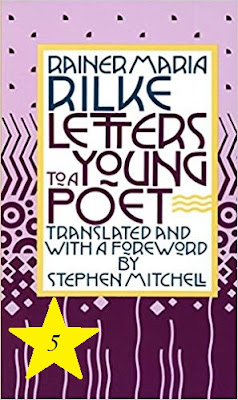
Letters to a Young Poet

Ten simple letters with quite a bit of wisdom behind them. This is one of the few books that I would here. Please read it.
want to keep sticky notes in so then I could refer back to them later. The whole text can be found online

Rainer Maria Rilke was a poet in the early 20th Century who wrote letters to a fellow poet who went to the same military school he had--though a few years different.

There are many things that happen throughout the course of these letters. They are in response to an inquiry of critique on poetry. We only get one side of the letters, but they are full of inspiration, not only for writers (young and more experienced) but in almost any avenues of life. He asks his reader to look into himself and ask "Must I write?" You can ask yourself, "Must I ______ <insert what you most enjoy doing--reading, math, accounting, look at the stars, etc>?" When faced with that question myself, I found that I didn't need to write. It wasn't a must. Reading, devouring knowledge, is what I must. (This blog has helped that, which is awesome especially considering how much I disliked reading when I was little.) But you can ask yourself, what must you do?

There are many other things which Rilke discusses with his pen pal. Not only suggested books that he says has wisdom in them, but he discusses critiques (not to read them), solitude, the passion of writing, taking on anxieties and sadness, taking on what is difficult whilst in sadness, that your doubts can be a "good quality if you school them."

It seems Mr. Kappas, the pen pal to which Rilke is writing, had some dramatic changes in his life that kept him depressed and Rilke was one of the people who tried to assist and give advice as to how to overcome them. His advice was profound and from what I've been able to see in my own life, very accurate.

Some of my favorite quotes are these:

"The only sorrows which are harmful and bad are those one takes among people in order to drown them out."

"You shouldn't be dismayed if a sadness rises up in front of your, greater than any you have ever seen before; ...Why should you want to exclude from your life all unsettling, all pain, all depression of spirit, when you don't know what work it is these states are performing within you? ... You know well you are in a period of transformation and want nothing more than to be transformed. ... You must be patient as an invalid and trusting as a convalescent, for you are perhaps both. And more than that: you are also the doctor responsible for looking after himself. But with all illnesses there are many days when the doctor can do nothing but wait. And inasfar as you are your own doctor, this is above all is what you must do now."

"And your doubts can become a good quality if you school them. They must grow to be knowledgeable, they must learn to be critical. As soon as they begin to spoil something for you ask them why a thing is ugly, demand hard evidence, test them, and you will perhaps find them at a loss and short of an answer, or perhaps mutinous. But do not give in, request arguments, and act with this kind of attentiveness and consistency every single time, and the day will come when instead of behind demolishers they will be among your best workers--perhaps of all those at work on the building of your life."