Wednesday, September 25, 2019

Girl in the Blue Coat

World War II stories are hard to read at times. This one is no exception.

Amsterdam, 1943. Hanneke (the audiobook had it sound like Hanika) works in her own little way to resist the Nazi occupation by being a black-marketeer in finding things that people need. But suddenly one of the ladies she normally finds things for has a missing girl that she wants found. Only this girl isn't supposed to be there. She is a Jew and has somehow vanished. She can't go to the guard, obviously, or other authorities, so how is she going to find this girl in a blue coat?

This was a very well done piece. It was written well and kept me very engaged the whole time. While Hanneke and the rest of the characters may be fictitious, the actions and events were very historically sound. The black market, the college resistance fighters, the theater and nursery across the street that helped save hundreds of people who would have died... These are all amazing things that Monica Hesse has portrayed beautifully, realistically, and powerfully. I very much enjoyed this and am even more interested in the other stories Monica Hesse has written.

I enjoyed the characters and how they felt lifelike. There situations and reactions to their circumstances were real and made me worry for them more than I worry for many of the other characters I read about.

I think Monica Hesse was a very brave woman to end the story the way she did. This is war and wars often down have happy endings for everyone involved. The ending was fulfilling and the focus of the story was different than most would suspect, which is also a very brave move for the author to do walking the fine line between what the plot needs and what the audience wants or expects. And I think she pulled it off well.

Good on you Monica Hesse. It was a very good book and one that I probably wouldn't mind reading or listening to again.

Friday, September 6, 2019

A Great and Terrible Beauty

I've had this book for years and only finally was able to read it. And I have mixed feelings about it.

in 1895,Gemma witnesses the murder of her mother, the murderer was some kind of shadow. How can she explain that to anyone? Months pass and she is sent to live in an all girls school and learn how to be a lady and curb her boisterous tendencies. Making friends is hard and making enemies is far too easy. To top it all off, shadows and ghost stories haunt her. She finds a diary of a girl who used to go to the same school and saw the same things she did; this girl had the same odd powers Gemma seems to be acquiring. What is is going on and who is the strange boy who followed her from India all the way to England?

I really liked the historical representation that was depicted her. A life of a lady was not an easy one and many felt silenced and purchased for potential wedding contracts. The idea of "lay back and think of England" instead of making love to a spouse is one of the many ways that this is shown here--nothing graphic though I guess there is some nudity which is probably unneeded. The idea of being a quiet, proper "lady" is very prominent and has many of the girls feeling stifled. So before all of their independence is snatched away they will occasionally do things that would get them in serious trouble if they are caught: necking is a gypsy boy, stealing the priest's wine/whiskey reserves, getting up at all hours of the night, going into the woods for meetings/gypsy fortune telling/whatever else. Then Gemma introduces her strange power to some of the girls and more craziness happens. But the idea of being stifled, silenced, and putting on a fake smile with even worse conversations only about "the weather and the queens health" was something that they had to deal with back then and now too in some instances though not as dramatically. It's sad and Libba Bray portrays that very well.

I think the characters were well developed and each was different and developed enough that I understood. I enjoyed learning about them and at times I felt very sorry for them. The characters were a very strong reason I finished the book.

That being said, I almost didn't finish. I am not an occult fan. This had a feel of the Salem Witch Trials to me, tarot cards, talking to the dead through medians, sacrifices to give black shadow/spirits power, and other witchy things was turning me off for a lot of it. I don't read it, because "bad ju ju feelings" are a thing and I don't need it around me. I did finish it though because the plot was very good. It was a very engaging read that had me turning pages quickly. I finished it in less than a week.

It is a good book and written very well. The reason I gave it a four instead of five stars would be because of the occult theme and the fact that it got a bit darker than I wanted. I can see this series being a good one that has many people very engaged, but as this moment I'm not going to be picked up the next one, sadly.

Wednesday, September 4, 2019

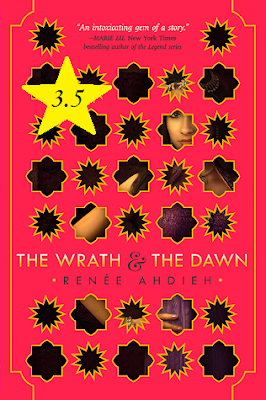
The Wrath & the Dawn

The Wrath & the Dawn is first in a series with the same name by Renee Ahdieh.

It is a retelling of the classic Arabian Nights story where the Caliph marries a new girl every day and every dawn has her killed. As to why is normally unknown. Shahrzad (Not spelled the traditional way), instead of running away, volunteers to become the Caliph's bride even in fear of the dawn in hopes that she can kill him for killing her cousin just a few mornings previously. She hates him with all her heart and wants to seem this boy-king dead. In order to do that she has to stay alive past the dawn, which she does by leaving the Caliph "hanging" with cliff hangers to the many stories she tells that last all night. He won't kill her, she thinks, if he's so intrigued by her stories and wants to know the end.

I listened to this as an audio book.  The reader, Ariana Delwari, did a spectacular job. She has a very nice voice and one that I wouldn't mind listening to again in future audio books.

I will say this, though, that my review may be a bit hindered by the fact that it took me a few months to complete the series. Not that it wasn't a good book, but time is an issue as well as the one big critique that I have to give... Shazi is so very annoying at the beginning. She irritated me badly with her mood, tone, and all out "Imma be ticked off and I have no redeeming qualities because REVENGE!!" It got very boring really fast and she has the same idea and stigma for a good third of the book (or so). I was more than happy to have her kiss the Caliph and actually start liking him.

The love triangle thing going on between her, the Caliph and her past love was kind of obnoxious. It took away from the traditional stories suspense of surviving to the dawn and the artful way of keeping the crazy king intrigued, and slid the in a rebellion, magic, and "I must save this girl who doesn't actually like me anymore because she likes the guy who killed her cousin." I didn't care for the past love interest. He was hot headed and seemed to only have a one track mind without thinking of repercussions. He didn't even think of Shazi's feelings on the subject, and every time she yelled at him to stop he wouldn't listen--killing some of her friends that she actually made in the palace. No points to you past love interest.

And one other thing, maybe because it was an audio book and not me reading it off the pages, but I had a hard time keeping some of the name in check. Shazi = main character, Khalid = Caliph, Jalal = kings cousin and captain of the guards?, T guy = past love interest, Despina = Shazi's maid servant and friend in palace, but pretty much everyone else's name got muffled in my brain and I had to rely heavily on context clues, which I didn't get all that often. With story names--which stories didn't last very long as plot points--as well as "irl" names, I got very confused.

The book did seem to flow well and the plot was constantly moving which was nice. Part of me though feels like it had major dollops of "Beauty and the Beast" put into it too. She goes from lots of hate and disdain to very much in love with him and tries to tell off the love from her past/Gaston-ish who would get slaughtered by the Caliph/Beast. While it flowed, I think there were many cliches for the YA market. There wasn't much that was "different" to really make it exciting and make me want to read it again. I might look at a Sparknotes for the second book, but I don't think I'll take the time to read or listen to the next one.

It was good for what it was, a retelling of an old classic put into YA form. It was written well with enough setting to keep us from the dark, though not much more than that. I liked Jalal, he was probably my favorite character and would have liked more of him, but he is obviously not the main character. Some of the others I didn't care for as much.

If you're wanting a simple, "traditional" YA read, feel free to pick it up.

Tuesday, August 20, 2019

Sense and Sensibility

Jane Austen's first published work Sense and Sensibility has been read over and over again for more than 200 years. It is a classic that has been loved and survived the years because it's a good book full of vibrant characters and an engaging story.  

After the death of their father, Elinor, Marianne, Margaret, and their mother are forced out of their home to live in a cottage in a different county while their half brother and his wife take over the family estate. Their time in this cottage, making new acquaintances and enjoying the countryside, is quickly changed to lovestruck conversations when Marianne is saved by a young gentleman and love blooms. For Elinor though love is a trying thing when she learns that the man whom she admired is in love with someone else whom she also is acquainted.

I think this book has stood the test of time, unlike many of the other romantic stories of the time, because it hits home more than some of the others. The things that Elinor and Marianne deal with, loss of father, home, loves, sickness, surviving monetarily as well as plain surviving your family relations and acquaintances. These are things that we all struggle with at one point. We read things that are often similar to our own lives via theme or circumstance. Sense and Sensibility does that, even to today, which is fascinating. There have been many critics, papers, articles, and readers of this book over the years and if you search them out can find a lot of enlightening information and opinions.

I like the play on opposites that is presented here. Elinor is the sensible one in the family (rather logic based) and Marianne is full of sensibilities (and can often let her emotions run rampant). Willowby vs Colonel Brandon, The Ferrar's brothers, John Dashwood vs Sir John Middleton, even the rolls that men play vs women and how they are portrayed (hunters vs mothers). The way Austen plays with opposites is engaging and can be thought provoking.

The characters, though, aren't only opposites of one another, but they are their own people. They aren't merely a stereotype but do have their own personalities and quirks that make them unique.

This, again, is an older book. Classic for a reason, but not everyone's cup of Sleepy Time tea. It's language is different and more wordy than what present novels give. There were times when I needed to put it down because my head was starting to ache or I couldn't pay attention because of how the language was constructed. It is what it is. I also have the Oxford World Classics edition which honestly read more like a textbook than a novel which might be published in a different format. But it did have a lot more insights, critiques, and definitions which were very much helpful and fun to look up without having to go very far. It also had a good introduction by Margaret Anne Doody who has done many other critiques and papers for the Oxford World Classics company. Again it was very enlightening to aspects that I didn't see my first "read through" during college. In the end, be forewarned that it is older, wordy, and "harder" to read for the "modern" reader.

Read it. Enjoy it. Take it slow if you need and please go and find articles about it. They can be very enjoyable.

Thursday, July 25, 2019

Be Prepared

Be Prepared was a cute little story about the trials of a ten year old misfit.

Vera doesn't really fit in with all the rest of the girls in her neighborhood. They are more wealthy, they have both parents, and they don't come from Russia. She moved to the USA when she was five, but the rest of the kids don't get it. They invite her to things, but she still feels like the outcast. During the summer they all go off to their own camps and she stays at home, until she finds out that there is a Russian kids scout camp. After some begging, her mom lets her and her brother go the following summer. Only summer camp isn't what she expected it to be. She finds that it's more of the same. She's the youngest in her troupe, they are all already friends and have known each other for years, and she's very much alone. Invisible. This is where she was supposed to find friends, so where are they?

It was a well drawn true-mostly story of Vera Brosgol's time at camp. She even has some of her letters and pictures from her time at camp. Vera is also the author of Anya's Ghost, which I didn't realize until I read the author bio.

I think this is a very potent and prominent story for many people. Trouble with friends is always something hard and pretty much everyone goes through it at some point. So it touches many people right in the hearts.

I think many people would enjoy this simple, well depicted story. It might even be one that I'd put on my bookshelf. Eventually.

Tuesday, July 23, 2019

The Watson's

I have learned now that it is important to read through all the introductions first in a book. They can be very helpful.

When I came across The Watsons at the end of my Northanger Abbey book, I started reading it just as I did Lady Susan not realizing that The Watsons was an unfinished work, almost along the lines of a blip from one of her other stories.

Our main character is Emma Watson who is invited to go to a Ball by a neighbor. She is set apart by her family as she looks over her invalid Uncle and doesn't get out much. She is given a diagnosis of the people going to the Ball and told whom to look out for. She is given offers to dance, seen by many, and gets the basic notions of those around her. There are visits after the Ball along with her family coming into town and trying to get her to come back home instead of enjoying the solitude and pleasant companionship of her Uncle.

It is only about forty pages and doesn't have much in the way of extended plot, but, as I said earlier, it's not finished. I think someone described it as a scribble. There is definite possibility for this story, and it resembles a bit of Pride and Prejudice in some aspects, but it is it's own story.

I found it very funny that the main character's name is Emma Watson, though I'm sure the actresses parents didn't know about this story. It made me happy. As for the other characters, there were so many in such a short period of time that it was hard to keep some of them straight. Few had solid characteristics in my mind that it was hard to keep many of them separated. I would have liked to read more about this particular story, but, alas, no such luck.

I did really enjoy one part of the story where the gentleman who would, if the story went on long enough, and Emma sat somewhat awkwardly in silence and talked some. It seems to be that that particular part might have been the founding part of this short story. It fit well and made me smile. Jane Austen has it well written, all of the story, but this part had that extra bit of "umph" to it that made me rather like the story and want more.

One other thing that I did struggle with, and it might just be that I have an "older" copy of the text is that there are sometimes four to five pages of text without a paragraph break. Pages full of conversation that has no breaks for the mind. This, I believe is only on my Oxford World Classics edition (that had awesome footnotes and explanations about the times) that had it that way. If I were to read it again, I'd go for a different edition, one that made it easier to read.

Miss. Jane, you need to "have an affair with the tab key." ~Mr. Bradley

Saturday, July 20, 2019

Northanger Abbey

Upon reflection, I realized I haven't written about Northanger Abbey and how much I thoroughly enjoyed Jane Austen's first written novel, thought it was published after she died in 1817 alongside Persuasion.

Catherine Morland was not born to be a heroine. That is how Jane Austen starts it. She isn't particularly pretty. She isn't super accomplished. As she grew, she started to love novels and reading. But being born out in the country, she didn't have much in the way of possible social interactions which is what a young girl in her station needed in order to find a good husband to marry. So, joining a family friend in Bath in hopes of finding that social interaction, she runs into a boy--well, man--who seems shrouded in supernatural mystery. Or maybe she's reading too much into his family secrets. Mr. Tilney isn't the only one looking to become better acquainted with the somewhat naive Miss. Morland as well. Love and potential Gothic encounters are in the air. Or maybe she's reading too much into all interactions.

This is one of my favorite Jane Austen books, so much so that I wrote my under-graduate thesis on it in college. Jane has her satirical fingers all over this book as she's poking fun of the Gothic novels that were circulating around her in her teenage years, when she started to write. Catherine reads these types of books and when presented with Northanger Abbey, which is Mr. Tilney's family home, she can't help but imagine secret passageways, diabolical schemes, ghosts, even vampires that reside behind each fluttering curtain. Jane Austen was critiquing The Monk, The Castle of Otranto, The Mysteries of Uldolpho (which she names specifically) and many others (none of which I've read). She pokes fun of them all because, in her opinion, they are kind of ridiculous.

I love the fact that Catherine isn't really the heroine of her own story. It says she is and it is her story but she doesn't save the day, she didn't solve a mystery (maybe I could give that one to her, but I probably wouldn't), she wasn't taken captive by a roving spirit where Mr. Tilney had to come and save her from a fire that the ghost started. No fainting spells, no vampires, no vindictive vendettas she needed to evade, or whatever. In part, she nearly lost it all because her imagination was wild and got the better of her.

Catherine and the rest of the characters are fun. Jane Austen is really good at making her characters human and realistic. Even though her writing style is older it works and stands well against time. Honestly, not many can do that well. They are human with fault and problems, with family who are sometimes the problem, with tempers, and schemes for marriages, for wealth, for love, for stability and survival. Jane Austen took the situations, and sometimes the people, around her and gave them to us to see. One could say she gave a big portion of the truth of Society to Society. (It kind of make me think of The Help by Kathryn Stockett. Such a great book.)

I think the biggest hang up that people have for this is the older writing style of Jane Austen's books. Modern minds have to take a second and slow down to actually think about what is being said instead of having the language be as simple as it is today. It's like they have to adjust their eyes and minds to the colorful words.