Showing posts with label 3.5 Stars. Show all posts

Thursday, October 21, 2021

The Convenient Marriage

 I've wanted to get into a Georgette Heyer book and finally found an audiobook, though I hoped for different. 

In order to help her sister escape away from an arranged marriage to save the family financially and to marry a man she loved, stuttering, nineteen year old Horatia Winwood steps forward and asks the thirty-five year old Earl of Rule to marry her instead. Intrigued, the Earl agrees and changes his proposal to Horatia and marries her. But not all is well in the house. An early agreement in their marriage was that they wouldn't bother one another about mistresses or affairs, but go on with blind eyes. With her blind eyes Horatia has found gambling and to spend as much money as she feels at the time. She's become lavish and in debt and incapsulated by the notorious gambler Lord Lethbridge who has very wide eyes toward Horatia. 

Georgette Heyer's book was very different from what I was expecting. Shorter than I expected. And it didn't have the "love story" feel to it as I was expecting as well. 

It had a heavy back drop of a simple "marriage of convenience," which is obviously fitting, and the unscrupulous side of "high society." Almost like the "gothic novels" that Jane Austen critics in Northanger Abbey. Gambling, duels, kidnappings, and not-so-secret affairs are most definitely things that aren't in the regency books I've read so far (though it was published in 1934, so very much written in a more modern style than what I'm used to as well).  So it was strange. Not in a bad way, but not necessarily something I'd enjoy reading again. I'm interested to read some her other books and see what happens in them. 

The reader, though, was Richard Armitage which was very surprising. Not only from North and South and the Hobbit movies, but an audiobook reader as well! He did all of the voices well, even the Horatia who has a very prominent stutter throughout the whole of the book. Well done. He made it more enjoyable to listen to.  

Monday, October 12, 2020

Peter Pan


Peter Pan is an old classic.

The Darlings' children get visited by the boy who never grows up and teaches them to fly. Off to Neverland they go which is the place of their fantasies, pirates, mermaids, Indians, and adventures galore. 

It is a fine book. One that can touch the lives of many people who are wanting to escape the bounds of growing up and knowing that we all need a mother--biological or "make-believe." This one will probably be one I'll read to my son because it's a fun, simple adventure. 

Reading it myself, though, wasn't as fun as I remember. The narrator in it was funny, in an odd way. Like an adult trying to be childlike, as opposed a child like say Wendy telling the story. It could be the fact that the audiobook was narrated by an older man, but it shouldn't make that much of a difference. The tone and fake childishness of the story put me off enough that I couldn't give it four stars. 

I've seen the play. I've seen the movies. The story is a good one. I like the emphasis and explanation we get for Mr. and Mrs. Darling. It makes them far more alive than even some of the movies give us. I also really like the implication that maybe, just maybe, when Mrs. Darling was younger, she too spent time with Peter. Maybe not off to Neverland with him, but stories and potential glances of him out her own window as a girl. 

I'd read it again for someone else, but for me I think I'll stick to the movies if I need a Peter Pan fix. 

Tuesday, February 18, 2020

Emiline, Knight in Training

Another book about Dyslexia.

Emiline is a knight in training, where she has problems reading, they move and are hard to read and understand. But she is a knight and there is more to her life and duties than just reading. She helps "tame" ogres and saves dragons eggs and helps her friends when they are in trouble. She does take the time to practice reading and because she is dedicated and asks for help, she's able to know when something bad is going to happen, she's also able to help her friends and teacher.

This is a very short book, something good for those who struggle reading wouldn't find hard or intimidating, that might give an extra bust in wanting to read and that it takes dedication to get things done. But that facing the challenge can be worth it and can help others.

It is a very cheesy book though, where anyone who isn't having these difficulties wouldn't like it as much as others. (But then again, I have a hard time reading very young books. I don't care for "dangerously cheesy" books.)

Wednesday, September 4, 2019

The Wrath & the Dawn

The Wrath & the Dawn is first in a series with the same name by Renee Ahdieh.

It is a retelling of the classic Arabian Nights story where the Caliph marries a new girl every day and every dawn has her killed. As to why is normally unknown. Shahrzad (Not spelled the traditional way), instead of running away, volunteers to become the Caliph's bride even in fear of the dawn in hopes that she can kill him for killing her cousin just a few mornings previously. She hates him with all her heart and wants to seem this boy-king dead. In order to do that she has to stay alive past the dawn, which she does by leaving the Caliph "hanging" with cliff hangers to the many stories she tells that last all night. He won't kill her, she thinks, if he's so intrigued by her stories and wants to know the end.

I listened to this as an audio book.  The reader, Ariana Delwari, did a spectacular job. She has a very nice voice and one that I wouldn't mind listening to again in future audio books.

I will say this, though, that my review may be a bit hindered by the fact that it took me a few months to complete the series. Not that it wasn't a good book, but time is an issue as well as the one big critique that I have to give... Shazi is so very annoying at the beginning. She irritated me badly with her mood, tone, and all out "Imma be ticked off and I have no redeeming qualities because REVENGE!!" It got very boring really fast and she has the same idea and stigma for a good third of the book (or so). I was more than happy to have her kiss the Caliph and actually start liking him.

The love triangle thing going on between her, the Caliph and her past love was kind of obnoxious. It took away from the traditional stories suspense of surviving to the dawn and the artful way of keeping the crazy king intrigued, and slid the in a rebellion, magic, and "I must save this girl who doesn't actually like me anymore because she likes the guy who killed her cousin." I didn't care for the past love interest. He was hot headed and seemed to only have a one track mind without thinking of repercussions. He didn't even think of Shazi's feelings on the subject, and every time she yelled at him to stop he wouldn't listen--killing some of her friends that she actually made in the palace. No points to you past love interest.

And one other thing, maybe because it was an audio book and not me reading it off the pages, but I had a hard time keeping some of the name in check. Shazi = main character, Khalid = Caliph, Jalal = kings cousin and captain of the guards?, T guy = past love interest, Despina = Shazi's maid servant and friend in palace, but pretty much everyone else's name got muffled in my brain and I had to rely heavily on context clues, which I didn't get all that often. With story names--which stories didn't last very long as plot points--as well as "irl" names, I got very confused.

The book did seem to flow well and the plot was constantly moving which was nice. Part of me though feels like it had major dollops of "Beauty and the Beast" put into it too. She goes from lots of hate and disdain to very much in love with him and tries to tell off the love from her past/Gaston-ish who would get slaughtered by the Caliph/Beast. While it flowed, I think there were many cliches for the YA market. There wasn't much that was "different" to really make it exciting and make me want to read it again. I might look at a Sparknotes for the second book, but I don't think I'll take the time to read or listen to the next one.

It was good for what it was, a retelling of an old classic put into YA form. It was written well with enough setting to keep us from the dark, though not much more than that. I liked Jalal, he was probably my favorite character and would have liked more of him, but he is obviously not the main character. Some of the others I didn't care for as much.

If you're wanting a simple, "traditional" YA read, feel free to pick it up.

Tuesday, July 23, 2019

The Watson's

I have learned now that it is important to read through all the introductions first in a book. They can be very helpful.

When I came across The Watsons at the end of my Northanger Abbey book, I started reading it just as I did Lady Susan not realizing that The Watsons was an unfinished work, almost along the lines of a blip from one of her other stories.

Our main character is Emma Watson who is invited to go to a Ball by a neighbor. She is set apart by her family as she looks over her invalid Uncle and doesn't get out much. She is given a diagnosis of the people going to the Ball and told whom to look out for. She is given offers to dance, seen by many, and gets the basic notions of those around her. There are visits after the Ball along with her family coming into town and trying to get her to come back home instead of enjoying the solitude and pleasant companionship of her Uncle.

It is only about forty pages and doesn't have much in the way of extended plot, but, as I said earlier, it's not finished. I think someone described it as a scribble. There is definite possibility for this story, and it resembles a bit of Pride and Prejudice in some aspects, but it is it's own story.

I found it very funny that the main character's name is Emma Watson, though I'm sure the actresses parents didn't know about this story. It made me happy. As for the other characters, there were so many in such a short period of time that it was hard to keep some of them straight. Few had solid characteristics in my mind that it was hard to keep many of them separated. I would have liked to read more about this particular story, but, alas, no such luck.

I did really enjoy one part of the story where the gentleman who would, if the story went on long enough, and Emma sat somewhat awkwardly in silence and talked some. It seems to be that that particular part might have been the founding part of this short story. It fit well and made me smile. Jane Austen has it well written, all of the story, but this part had that extra bit of "umph" to it that made me rather like the story and want more.

One other thing that I did struggle with, and it might just be that I have an "older" copy of the text is that there are sometimes four to five pages of text without a paragraph break. Pages full of conversation that has no breaks for the mind. This, I believe is only on my Oxford World Classics edition (that had awesome footnotes and explanations about the times) that had it that way. If I were to read it again, I'd go for a different edition, one that made it easier to read.

Miss. Jane, you need to "have an affair with the tab key." ~Mr. Bradley

Monday, October 22, 2018

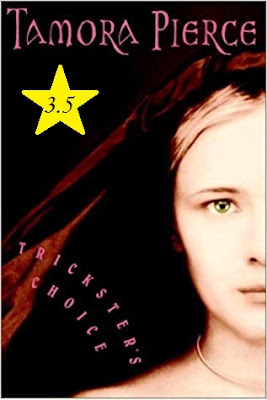
Trickster's Choice

Tamora Pierce is at it again in the Trickster's series. This book is based on Aly, Alanna's only daughter.

Aly has the Sight from her father and a heavy dose of magical power from her mother. Unlike her mother, she has no inclination of being a knight of the realm, but instead wants to be a spy like her father. However, being the only girl in the family and knowing the world of spywork first hand, her parents keep her only in the back rooms transcribing notes and reports from spies in the field. Aly wants more. She wants an opportunity to prove herself. And, boy, does she get one.

While sailing north to get away from her mother's temper, her small dingy gets overtaken by slavers and she becomes sold into slavery in the Copper Isles--which is known for its crazy nobility. However, the family she is sold to has a God looking after it, her father's very own patron God, and has a touch of destiny about it. She makes a deal with the Trickster God: keep the children of the Balitang family alive throughout the summer and he will make sure she gets home to Tortall safely. How hard can keeping a bunch of high ranking nobility safe be right?

This is just not my favorite series of Tamora's, which is sad. I think it has great promise and if I remember correctly, the next one is really good. I hope it's really good. This is actually the first book I picked up from Tamora Pierce which my friend made me put down and pick up Alanna: The First Adventure instead. Don't read this if you haven't read the other books first. You will miss out on a lot of things and be very confused on many of those same things that are presented.

This series is a big change for Tamora and her writing. Here she is doing something very different from her past series. It is her first first-person-point-of-view novel as well as her first single book of such a length. Tamora has slowly been getting long, but this has more words in it than even Lady Knight. With this expense I feel she runs into some problems. I feel like she didn't do enough with the first person POV. There felt like very little emotion, that we normally get through that type of POV, wasn't there. There was very little internal dialog or thought that was conveyed which made it feel like Tamora had simply switched it from third to first by changing the "she"s to "I"s and kept writing. There is supposed to be more of an internal view when it comes to first person that I don't think she grasped here.

The other part I didn't so much like was the long periods of time where nothing seemed to really be happening. This is my second read through (though the first time I read it was probably fourteen years ago (yikes)) and from the time when I first read it to now, I could only recall a few things that happened. They were at the climax and at the very beginning. They were basics. Like crows turning human, the guys name is Nawat, and Aly was a slave. I didn't remember much from the first book at all like I do in other stories where I revisit these awesome moments in my mind over and over (I do this a lot with the Stormlight Archive or in The Immortals series.). I honestly didn't remember that she was a spy (until my friend commented on it and I was like "What? Really?"), because there wasn't much spyness to it. She could pick locks, she searched through people's stuff and waited. I guess that is a lot of what spies do. They wait. But in the need of an engaging novel, it didn't have very high stakes when she was spying. There was not a thought to her getting caught because she was just so good. There was never that tention or her needing to hide in a closet or behind curtains because someone came back to their rooms early. Most of the time I can bust out a Tamora Pierce series in a month, all four books, but this single book nearly took me a month to read by itself. I needed to grab some graphic novels while I was at it because Trickster's Choice was slow and I needed a pick-me-up.

I do also think that when it came to the "slave situation," things were over simplified. It was very much glossed over with "the Duke and Duchess were very kind to everyone" then the grand generalizations of "bad things happened to other slaves by other masters." There were one or two mentions of what 'bad things' were, but not enough to really compare and get a feel for the real world of the Copper Isles.

Now, Tamora's writing in it I think was lacking. It was slow and not as engaging as The Immortals series or Protector of the Small. But there were really good characters. There was a whole cast of different people with different personalities and different things they were good at. Dove and Sarai were dramatically different and very easy to tell apart--whereas sometimes in the past it is hard to tell sisters apart and they almost come in a set. This is not the case for them. The duke and duchess were very different from their peers in that they were kind to everyone in their household, servants, slaves, men-at-arms, etc. They were supposed to be different which made it easy for the reader to like them. I do wish we were given a reason as to why they were so kind to all, not just "because reasons" or "because plot," but something more solid. Kypiroth, the Trickster himself, was fantastic. Very much reminded me of my favorite George in manors and humor. Nawat was very sweet being a crow who turns human to help Aly (reasons are given, so although it's odd it's still valid). His constant talk of fledgelings, hawks, snakes, and mobbings alongside his devotion for her and his own quirkiness made him endearing and someone I really liked. I do wish the little raka committee that Aly becomes a part of differentiated the people a little bit more. The names got to be kind of obnoxious and it was hard to tell some of the men apart.

I do have another qualm with Aly, herself. She's too good at what she does. At the beginning when they are traveling to the outer estate and all is quiet in the woods, she knows better than the Duke's guards and people who are three times her age who had done this before she was born. Yet, she knows better. That rather irked me. She is smarter than practically everyone around her even people who are supposed to be veterans in one thing or another. There also isn't a time when she actually fails. She's perfect and doesn't do things wrong. There are people who die towards the end, but the characters were all prepared for that or plot for the second book needed to happen. I wanted to cry for them especially one character, but I didn't. Aly wasn't even there when the death happened. I wan't emotionally invested because Aly wasn't invested. I also think her Sight is a cop-out for description. There is no other use for it, really, except to describe things for the reader. Other than that it is almost completely unneeded. She doesn't use it for finding mages or looking into locks or something. She hardly uses it at anyway. I feel like she could have used it better.

I wish I liked it more. I will, of course, be reading the second book in Aly's series because it was better. Read on, readers. Read on.

Monday, September 24, 2018

Not If I Save You First

A survival stand alone.

One would suspect the President's son and the President's Head of Security's daughter would become friends, right? They have. They know every nook and cranny in the most famous house in the world. But after an incident, Maddie's dad is injured and they leave the luxury of the White House of the barren forests of Alaska. Six years pass and not a single letter has come back from the White House even though Maddie has sent them religiously. Maddie has learned to survive with the help of her bedazzled hatchet with no one else around for tens of miles--no one but bears that is.

Suddenly, Logan is here. In Alaska. Six years of no reply and he is here. And Maddie hates him. Can't stand the sight of him.

Her father leaves to go rescue someone before a storm and Maddie is left to watch over Logan (with the help of his Secret Service agents just outside the door). But suddenly, the agents can't be found and Maddie is thrown off a cliff and Logan is taken hostage by a Russian who forces him to cross the wilderness. Maddie is injured but managest to follow the two young men. No one gets to kill Logan except her. That is the rule.

It was a good story, much like the many that Ally Carter has written, and this race for survival was fun. Unlike her other books, this is a real place. Not some made up country where she can do her own political thing. She did her research well, from my vantage point.

The kids also felt very real to me. They were who would bedazzle a hatchet or make multiple social media accounts that your parents wouldn't know about. This one is very different from Ally Carter's other books where they are so many characters; here the pertinent characters number four or five. And I think it worked well enough. Maddie's voice was very prominent and sounded very much like a teenage girl who at least used to adore some frills and bedazzling. I very much liked her voice.

It isn't my favorite book  in Ally Carter's arsonal, but it was decent. It still had the "heist" feeling that I got from the Heist Society where Maddie is very smart and thinks ahead. I also really like how she jumped points of view with Maddie and Logan. It was needed to tell this story, and I think she did it well.

If you want a standalone book, feel free to pick it up and enjoy. A quick read, but full of adventure.

Wednesday, August 8, 2018

Tempest and Slaughter

Tempest and Slaughter is Tamora Pierce's newest book (as of so far). This is the story of Numair before he became Numair, when he was a simple student in Carthak City studying to become a great wizard, back when he was known as Arram Draper.

Tempest and Slaughter follows him as he is growing and studying at the Mage's school and shows more promise than many of the other students. He is the youngest student training to become a Master and flies through the ranks of his fellow students. He is often board and that gets him in trouble. One of these incidents leads him to become friends with Ozorne ("the forgotten prince") and Varice (a beautiful girl from the north). Between plagues, school, and the gladiator arenas there is a lot for the future Numair to do especially when death comes to call and conspiracy looms in the shadows.

Numair is one of my favorite characters. In the The Immortals series and Protector of the Small, I light up every time he's in a scene. I think I enjoyed this more because I knew where many of the characters were going to be later and what they would become, more than I enjoyed the actual book. I loved the little unexpected blip toward the end when I figured out who a particular character was. It was awesome!

Getting to know the environment and setting of Carthak was interesting and intriguing. It explained a lot of where Orzone came from and why he acts the way he does in future novels.

I feel like this is really only half of the story. There is a book two that will be coming out in 2019, but without it seems like we only have half a plot. The "climax" at the end was lacking even though it kind of rounded out the story, but it just wasn't enough for me. I think Tamora Pierce could have done more than just a timeline plotline. He grew older and advanced through the ranks... There is an underlying plot with the Princes and hints of conspiracy, but we only get a nibble. It was almost as if Tamora had too much she wanted to put in the story that the plot almost vanishes. There isn't enough of it to be considered a great book, in my opinions. I still enjoyed the book, just not as much as I was hoping for.

If I would suggest this book, I'd suggest it to someone who's already read Daine and Numair's story, at least until The Exile's Gift comes out. Before then though, make sure you read at least the four books in the Immortal's series. You'd enjoy it so much more then reading this alone.

Thursday, May 17, 2018

Tell No One

Tell No One by Harlan Coben is a mystery novel I had recommended to me by a friend when I was in search of an audiobook. Steven Weber did a great job reading and getting different voices in. There was a large bunch of segments that gangers from the harder parts of New York and I believe he did them justice. They seemed the most visual and realistic of the characters, from listening to them.

This mystery starts out with a husband and wife off on their anniversary down by the lake where no one is around. But as Beck goes to a raft in the middle of the lake, Elizabeth, still on the beach, screams. Beck is knocked unconscious and when he comes to Elizabeth is gone. Her body is found a few days later dumped on the side of a road and the serial killer that has been rampant torturing and killing young girls is caught. Eight heartbreaking years pass and Dr. Beck, Pediatrician, is going through life though "life" is a big word for what he is living. Suddenly, he receives a strange email with odd clues that only Elizabeth would know. A hyperlink sends him to a website and there she is. Elizabeth. Could she really be alive!

Poor Dr. Beck. He goes through hell once he opens that email. More bodies are found near the lake where Elizabeth was kidnapped, he does in for questioning, people are tapping his computer and phone, suddenly he is on the run and the only people that can help him crack dealers from the wrong part of town. He is beaten up, dressed up, and wanted for murder. All on the same day. Yay! *sarcasm*

It was a very interesting novel, though probably not one of my favorites. If I, personally, was reading it I would have had a hard time, but listening to it I was able to get through it. Not that it is a bad book. Probably just not my cup of tea. It had a good premise and solid enough characters. But I found the ending to be rather predictable. The foreshadowing was good and let me make my predictions.

I do wish the other characters had been more developed. We had a very telling description of one character and but very little to describe the personality of the others. I get that Dr. Beck loved Elizabeth, but I felt no reason to love her, no longing for her to be alive. her father had more of a personality as being a gruff cop who was in the service for a long time. I even feel like Beck was just a cookie cutter person. He had no interests. He went to work and that was it. We get nothing really before Elizabeth's abduction of what he was like, nothing of what he stopped doing. Stopped going to games or playing poker or anything. I think it mentioned he drank when he was feeling really down. And I guess he had a dog for about two seconds in the book. But there was very little about him that actually made me like him or any of the other characters. Tyrese was the most likable but in the end he seemed like and means to an end.  :/ I want some good bad guys that I like and full, deep main characters. I don't feel like I got that here. Instead we got some cookie cutters.

Setting lacked a lot and we seemed to jump from one place to another rather quickly. There were parts where the scenery was very well described, but they weren't ever in the action. There would be long blocks of passive description. A few of my friends would probably skip them while reading because they were so blocky.

The big that it has going for it was the story. I really liked the plot and how things flowed. There were some parts though that didn't make sense. The ending was too easily wrapped up except for some loose threads that didn't make it into the bow. Like Coben had an idea and how he wanted it to end, but when the tell all at the end happened it didn't quite match the ending he had in mind. The rest of it though, the weaves and curves were pretty cool.

Would I suggest this book, not so much. Might I give Coben another chance? Maybe. Though not in the near future.

Thursday, April 5, 2018

Stitches

Stitches: A Memoir is a graphic novel of David Small and his time growing up, his hardships growing up.

David Small is a Caldecott Award winner for his illustrations for The Gardener, one of my favorite picture books while I was growing up. Everyone should read and enjoy it. He has gotten many other awards for the work that he has done over his 73 years.

Stitches begins with his experiences in hospitals. His father was a radiologist and his mother always seemed to be cranky. He was often sick as a child and because his father worked in the radiology department, he was able to have x-rays done to see what the problem was. As the years went on, as he grew alongside his brother, he found he had a growth on his neck. It grew until his family was finally able to do the surgery. However when he woke up, he found he was unable to speak. The surgeons cut out his thyroid and half of his vocal cords. As, again, years passed he was able to gain a raspy whisper, but his voice, of course, was never the same. He found solace in drawing and later illustrating children's books.

There is far more to the story than simply his voice, though it is a major part. But there are trials when it comes to the crazies of families. Deciding whether or not to continue on in family traditions and conditions or not. His story makes me even more grateful for my own mother. The way he drew his mother and grandmother reminds me of one of my grandmothers, not the temperament but the style. The round glasses and uppy hair. But the way he drew her instantly made her instantly one of those scary old ladies that I was afraid of when I was little. So to have her as a mom, I'd be almost scared my whole life.

I very much enjoyed the book. Very well done.

Sunday, December 31, 2017

Junie B. Jones Is Not A Crook

I've been trying to read a few easy novels with my five year old son for the past little while. So I picked up some of the children's books I had growing up that I thought he would actually sit down and listen to. Junie B. is the one he picked out of my small-ish collection.

Junie B is a kindergartener who is just figuring out the world. Figuring out school, friends, the do's and don'ts of the world. This is book number 9 in the series, my son picked from random. In this story, Junie B. loses her  new, fluffy, black gloves that her grandpa gives her. She discovers there is a lost and found, but it's not there. Obviously upset that someone took her fancy gloves, she thinks they are all crooks. But then she finds a fancy pen under the drinking fountain, she believes "finders keepers, losers weepers is the rule" so she keeps it. Then comes the moral dilemma of a five year old.

It's alright. Good-ish for children who are starting to read. The morals to the stories are good and hopefully my son will realize that it's not good to take things that aren't yours. (I wish some people would choose that road more often then they do... *grumble grumble* my ring I lost *grumble grumble.

Junie B. is also a hoot. I think she is fun and she definitely has her own personality that often drive the adults around her nuts, just like many of children in general. That is very much authentic and fun.

My only real problem with it though is something that my own mother pointed out to me and why she doesn't care for the books--though she got them for me and helped me read them because they were some of the only things I'd read. My problem is that Junie doesn't speak grammatically correct. I have a five year old, I get that it is more authentic or real to the character to have her speak oddly at points, but there are other characters that don't speak so strangely. If we are trying to teach the children who are reading these books to speak well, shouldn't the main character speak more clearly? Yes. Even reading aloud myself, there were sometimes I'd have to catch myself because Junie B wasn't making grammatical sense. Teaching children to read and the societal constructs of what to expect I think is more important at this age than this particular growing curve that she has.

Wednesday, October 18, 2017

The Appearance of Annie van Sinderen

The Appearance of Annie Van Sinderen is a ghost story without ever using the word "ghost."

Wes is a media major assisting his friend who is producing a small film for their college summer school class. They go to a seance to hopefully see a ghost or something spooky. What they don't realize is that they actually spotted one. Annie bops in and out of 1840 New York to the present in hopes that she can find out what happened to her and her family and, more specifically, what happened to her cameo that her beau gave her that has gone missing. Wes and very few others can actually see her and search to find out what happened.

The story is cut into three parts: Wes, Annie, and West/Annie. As Wes figures out that Annie is a ghost we jump to her story and what happened throughout the week before her demise. But as she flashes back to the past, she's able to change things, or is she? She acts differently around others and they, in turn, respond differently. She is able to find new clues to her past and what happened.

I think the book is well written, but for those who don't care for heavy description, be ready to skim/skip parts. It if full of heavy description. Though interesting to see what it is like to walk the streets of present-day New York through the eyes of someone who hasn't seen buildings higher than three stores. That was fun. I liked the difference of views that were subtle throughout the story. When we are reading through Wes' point of view, it is different with different things emphasised than it is through Annie's. She focuses on the "cushioned chair" or small delicate things, whereas Wes sets his focus like you would a camera. I thought that was well done. It also definitely showed what it is like to be in a nineteen year old boys mind.

The transition between the two times was easy to see, though sometimes a bit long in description.  I understand that sometimes that transition can be sticky, but she Katherine Howe did it well.

Um... aside from that, it took me awhile to get it finished. I found it easy to put down and I knew what was going to happen well before it did. I finished it because I wanted to see how it was going to end and if I was right--which I was. It's not one that I'd be eager to pick up again, but it was alright.

I'd suggest this for a light read if someone wanted it.

Saturday, August 19, 2017

A Certain Scientific Railgun

A Certain Scientific Railgun is a manga based in "Academy City," what once was Tokyo but has become the base for all espers--or those who have psychic abilities. The story follows Misaka, a middle school girl who is already one of the top seven espers in the city and is super powerful. She has friends who are in Judgement, an esper focused police force, but somehow she ends up being in the middle of everything.

Over the course of the first ten volumes (70 chapters) *there are actually twelve volumes but two of them aren't in english yet, and I can't read Japanese :/  ), there are three story arcs that for a while seem like they don't correlate, but then somehow kind of do. The first (in volumes 1-3) we get to know the characters and find out that there is something called a "Level Upper" which can make the abilities the espers have go up a "level" and become more powerful. However what the public doesn't know is that after a few days you fall into a coma that is really hard to come out of. When they find the culprit, a major battle ensues, and Misaka finds that there is more to Academy City than she thought.

Arc two (4-the first half of 7) turns dark. Like rather gory dark. So much so that if it didn't lighten up I was going to put it down. Volume 4 is probably the darkest and most gory, but then once the reader understands what is going on, they step back from the gory and  become more investigative and they find that scientists in Academy City are making clones of Misaka. The plan is for 20,000 of them. However, already about 10,000 of them have been killed already. What is going on!? Stay tuned to find out.

Arc three (7.5-10) corresponds with a citywide festival, every good anime/manga needs at least one right? But now that Misaka has the clone thing under control, they are disappearing and people are after her. So many people with unknown agendas and suddenly none of her friends remembers her. It's as if the whole city is out to get her.

It's because they pretty much are. Of course.

Overall, it was okay. There were moments of "yuri" and moments were girls had no clothes on (though nothing drawn that would be porographic, but might make some uncomfortable) and the battle scenes seemed to last novels. Volume 5 consisted of mostly two fights. They happened in different stages, but it was long. She fought. "Yay!" Can we move on now? Some of the fights were pretty cool, but others seemed to drag on. Easy in a manga to skip, I guess.

At the beginning it teased a romance between the only boy mentioned in the series and Misaka, but almost nothing happened. It almost seemed out of character for her to even be talking with the guy at all. But he is needed at the end so I guess he has to stay around because of what he does.

At the last climax, which I was really into and was really cool, we jumped between characters because Misaka is incapacitated... kind of... and the only reason they were able to get out of the mess was odd. While I got how things started to collapse for the bad guy, I felt like it was too easy. I mean the girl who finally took out the bad guy had a heck of a time doing it, but I saw how it was going to be done a volume before it actually happened. But then the bad guy died (is he actually dead?) and things calmed down real quick and it was weird. Maybe the next two volumes, that I can't read, work things out, but this just felt weird. It summed up, but it felt unfulfilling.

This one I probably wouldn't read again, but for those people who really like blowy-uppy books, you'd probably like it. I have a feeling this series was meant for boys. Fight/action scenes, obnoxiously big boobs, sometimes naked girls, a little girl loving girl thing... Yeah. Misaka was a very powerful main character who could take on the world... But there were a bunch of questions I feel were left unanswered or were given a quick <insert answer to major problem here> moment. Eh, yeah. Probably won't read it again or the remaining volumes.

Saturday, July 22, 2017

Realms of the Gods

This one, even though this is the end of the series where the large climax and final judgements are made, is my least favorite of The Immortals series by Tamora Pierce. The mood of the novel changes so dramatically, so very quickly. It is the darkest of the books and it starts out dark from the first pages and it ends dark again.

In the story, Ozorne got away and has amassed a giant army with the help of the Goddess of Chaos (whom probably should have been introduced previously, but wasn't) and has been causing a lot of havoc in Tortall. When Numair and Daine go out of the fort they were defending, they find that the Skinners are too much for either of them to handle and are only saved by Daine's mother and father and taken to the Realm of the Gods. Finally reunited with her mom and finally really meeting her dad, she still finds it weird and feels she doesn't know this woman who is now the Green Lady. Also, knowing that her friends are still in trouble back home, Daine wants to get back home to help. So her dad gives her a map of the Realm and sends her on a journey to the dragons, because they can't send her back themselves.

In my opinion, this journey seems a little unneeded. We do get introduced to Gold Fleck and the other darklings, Numair and Daine finally tell their feelings (which I will get to in a moment), and they meet up with Stormwings from previous books. However, the whole Hero's Journey that happens I think should have been done differently. The glimpse that we got of the realm was small and all they did was travel through it. Nothing they did their enhanced or hindered the people in the other realm, except for when they sent other Lesser Gods away to help out. Daine and Numair didn't do much. I feel like they should have been able to do something besides let things get steamy. In this Realm we got to know the Dream God who let them know what was going on in the human realm. this seemed like a cop-out to me. "Here have information, but not enough that I have to get too into it." :/ Come on. Make your book a little thicker and give us the actual fear that people were feeling. If you're going to have it be dark, give us chances for happiness too. In the other books there was humor and laughing even at just small parts. Give us the people we spent time with and got to know... In the end, I thought it was boring. Unneeded or needing to be advanced.

For the relationship between Daine and Numair, it was the only thing that grew on their journey. There were small things that Pierce did to say, Numair kind of likes her. But this was the first book that actually had him show any affection and after these small moments, he's kissing her face off and things start getting steamy. Pierce should have done a few more tell tell signs of it in book three, more than just telling the crown prince off. I think it would have been more believable.

Pierce got much better at setting than when she first started, I'll give her that. But it took me longer to finish this one than the others. It finished off the series and wrapped everything up, even with the God and their own battles, but I'm dissatisfied with it.

Saturday, June 17, 2017

The Woman Who Rides Like a Man

The Woman Who Rides Like a Man by Tamora Pierce is the third book in the "Song of the Lioness" series. This one is probably the most "sequal" like book in the series where it feels like not a lot is going on plot wise. Or that the things going on aren't necessarily around Alanna. Things happen, but it would have been nice to see them happen instead of simply Alanna vague "what is happening" moments.

Alanna starts going on adventures at the beginning of the story, but the only one that Pierce presents is Alanna's assimilation into the Bazhir (in my head it always ended up coming out brazier instead, oops), a desert people. Very stereotypical Middle Eastern, much like how many other peoples in these stories. She becomes part of them and starts changing some of the ideas that the older folk believe, namely that women can be warriors, they should have their faces veiled at all times, and the shaman of the Bloody Hawk tribe thinks she's a demon and acts accordingly.

Her love life is what expands in this story. Jonathan, because of their adventures in the first book of the series, is offered a prominent part of the Bazhir culture and spends a lot of time with Alanna, even going so far as to propose. Things become complicated, she finds George who has Rogue complications of his own and things become stagnant.

I would not suggest reading this book during the high of summer because it takes place mostly in the desert. I constantly just felt hot and pretty miserable what with it being June.

This book lacked greatly in my opinion. But you need to read it, if not skim it, for context of the fourth book which is much better. I felt as though Tamora Pierce didn't quite know where to go when it came to book three though she knew where she needed to be for four.

The characters do grow up in this book, though it is only a little. While Alanna obviously has her faults, many of the boys do not. Jon gets kind of snobbery, "because he's a prince" so he's spoiled. George doesn't really have any faults except he likes to collect ears for those who have betrayed him or done him wrong and is a thief--though we don't get much on the side of his thieving. Many of the other side characters feel flat to me still.

Pierce's writing did get better. Her dialogue isn't as childish as it was in the first book. She's been able to get different characters do act differently instead of having the filler characters of Gary and Raoul (at one point when I was first reading I couldn't tell them apart). I do wish she would do better on settings. Yes, it is the desert, but i felt the same as I did for Under A Painted Sky and the lack of setting and description thereof. People have made so many poems of nature over the centuries, why can' they think of something pretty amongst the sand dunes and dried rock? I don't know if they were covered in sand all the time or if they were near a mountain or what. It was almost like <insert "dessert" here> at times. It's okay to let the make up some of the setting in their mind, but descriptions are good too. This is the writer's world we are stepping into, don't let us do all the work (some, yes, but not all). I like to know where I stand.

Wednesday, March 22, 2017

Bloody Jack

Bloody Jack by L.A. Meyer is about a girl who dresses as a boy to join His Majesty's Navy to take down pirates. Coming off of the streets with nothing but the clothes she took from a dead friend, she starts her new life as a Sailor Boy who assists those who are actually in the Navy. She can't let her secret of actually being a girl get out, otherwise who knows where they will drop her off and leave her. She has dreams of being a sailor and seeing far off places and going on adventures, so she hides herself in plain sight as a small boy on a big ship.

This was okay though I was hoping for more. There are a whole bunch of books in this series full of all kinds of adventures so I'm assuming it gets better. It starts out with her turning maybe 12 (faking 10 year old boy) and supposedly two or three years passes. It didn't feel like that too me. There was no mention of time until almost the end of the story and the rest of it felt glossed over. It was written in a past tense, which is normal, but as if written by someone much older while at the same time the accent that is used in the writing shows that it should be more present tense or at least closer to the actual time it occurred. I guess what I'm saying is that the narration is very distant from what is going on in the story.

At the times of high intensity, fighting the pirates and whatnot, I was never scared for her--this possibly had to do with the narration style, maybe something else which I can't put my finger on.

Half way through the novel, when one of the boys finds out that she is a girl, the story turns to them necking the whole time. Every moment they could get they held hands or kissed or touched each other or something. I felt like I might as well have put them in a hallway of a high school or something. That was all it was about for the longest time and I got bored. It was a good thing she got in fights with her other crewmen and pirates, otherwise I would have put it down.

I did enjoy the some of "Jacky's" quirks and the fact that she doesn't see herself as brave. She becomes Blood Jack because she kills a pirate to save a friend. She survives being on an island on her own for a while. I even liked the reality of when she is finally discovered that these gentlemen sailors treat her like a girl of privilege even though she was a beggar off the street at the beginning. Of course to keep her "safe" they put her in the brig (as there is really no other place they could put her, so they say) and have guards on her 24/7, which is excessive in my opinion. If there was a lady that they had saved from pirates, they wouldn't have put her in the brig. So why Jacky? The whole ending was weird. And the awkwardness of suddenly realizing she is female was never really mentioned. Sure they treat her different, but none of them mention any awkwardness or weird looks. I'm sure that would have happened.

The setting was kept simple but we were given enough information to make a guess as to what was going on. Though I kind of wish there had been a tad more where we could have learned more about ships.

Aside from Jaimy and Jacky, most of the characters were kind of flat to me. We weren't give backstories to many of the others. Super brief glimpses maybe, but not enough to give them more than a stereotype.

I think the story has a lot of potential, but right now I'm kind of disappointed. I'll read the next one, but if it doesn't pick things up greatly, I won't read more of the series than that.

Friday, August 26, 2016

Under A Painted Sky

Under A Painted Sky is a nominee for the Beehive Award and for a reason. It is about a Chinese girl, Samantha, in Missouri in 1849. Tragedy strikes and she quickly finds herself an outlaw and on the run with a runaway slave, Annamae (*cough cough* close to Anime much? Anyway... ).They head west to California under the disguise of boys off to the Gold Fields. One night two they find themselves in the much needed company (for survival as criminals and in the wild west) of three cowboys.

This is a YA book, so, of course, the law of attraction takes a big role in this story. Girls like boys though trying their best to act like boys, boys are confused.

It's language was beautiful. The dialogue was "ingenious." There were a lot of characters that came from different places and had many different accents. Mrs. Lee tried her best to imitate the accents with how she wrote it, which I haven't seen very often, though I've tried to replicate. The metaphors and similes were masterfully done and well thought out. If I was trying to teach a Creative Writing class about good metaphors, I would suggest this book. For plot and setting, however, I would not. This is an extremely character driven book where the need and development of the characters took precedence in the author's mind. I think the story was set up well in the development of the characters, use getting to know them and their backgrounds. This is super important and, as I said, was well done.

There is also a lot of witty bantering back and forth between the characters that made me laugh. I enjoyed that immensely.

It had great little morals to the story throughout the book. Little perks of ancient Chinese/Biblical wisdom. My favorite one was, "Maybe what matters is not so much the path as who walks beside you." (I think she took this sentence to heart though when she resented setting and plot.) And the overlaying idea that race shouldn't stop love. Asian, hispanic, black, white, it doesn't matter. I like that.

There is some cursing scattered throughout the book, but I was surprised that they said "Dang" more often than not. One of the cowboys tended to get around with the ladies, though he gets pummeled for it. There isn't anything graphic in the book even though there end up being a handful of dead guys scattered like the curse words.

I did have a huge question: if she is Chinese from a Chinese father and mother, why is her name Samantha Young? Young I could see. But Samantha? For such an English name for a Chinese girl? There was no reason given as to why she wasn't given a Chinese name. Her father didn't hate China and taught her a lot about China and the culture. So why Samantha? o.O?

I also felt like the plot was lacking. The story is based greatly on the love connections between the characters. But the slowly progress towards California takes a massive back seat where it is almost forgotten. Something as important as the "quest" of a story shouldn't be as much of a shadow as it was.

But the biggest downside to me was the setting. It was minimal. I will give the author a little bit of sway what with them walking through prairie lands with grass and rocks being the only landscape around them. However, there are many poets and songs written about the prairie and surrounding lands. The rock formations that are out there are magnificent. Also, while the characters are in town we get no description of the town or the rooms that they are in.

At the beginning, Samantha is in a hotel room (I think) where the only description we really get is a bathtub and a bed. Not the colors of the sheets or type of tub, not the color of the wall paper or any other furniture in the room. I know of some readers who skim through setting descriptions (You know who you are. *wink wink*). That is okay. There can be sometimes when you can get bogged down with description, but there was such a lack of it that I felt left out.

We should be good readers and be able to fill in the blanks as needed, but this seemed almost like a lack of research. These names that Mrs. Lee gives as landmarks, aside from Independance Rock and the Forts they pass, I had a hard time finding online. How made up are they? If she is going to make up cities/landmarks, which she has every right too mind you, couldn't she give us images of what it looked like. Make us see more than the tree she is sitting under. More than just a river that had fish in it.

It's ironic that the title is Under A Painted Sky when the beauty of the landscape around is left out of the book for the most part.

Over all, I would recommend this to particular people, but not to everyone.

Monday, July 18, 2016

Phantom of the Opera


I've been in a classic kick recently and picked up Phantom of the Opera. There were two reasons why specifically picked up this classic, one of my friends was consumed by the "phantom" character a few years back, and I love the musical that has been on Broadway and on the silver screen. I think the music they put to the story is majestic and the psychology  behind the mesmerizing and control that happens in the story.

For those who don't know the synopsis of the story, there is a ghost in the Paris Opera in the late 1800's. It does strange things and all the ballerinas, dancers, and singers believe that any shoe lace that breaks or pitcher that falls over is because of the Opera Ghost.

Unlike the play, there is a death in the Opera in the very first chapter. Joseph Buquet is found dead in the cellars of the Opera, supposedly hug, but with no rope. Inside the Opera, accusations of the Opera Ghost circulate, but nothing can be done. He is a Ghost after all.

Then, on the night of the gala when managerial positions are transferred to new owners, Christine Daae faints after her first and astounding performance and is rushed to her rooms. Having come to consciousness, she faces her old friend from the sea, Raoul, who has fallen desperately in love with her because her singing touched the hearts of angels. She orders everyone out and Raoul, listening at the door, hears her talking to a strange voice.

A few days later, after another performance, she is abducted and everyone is frantic about where she's gone. But after two weeks she comes back but refuses to sing as she had before. She sends a note to Raoul to meet her at the sea side village where they spent many years together. One night while there, after an argument between them, Raoul follows Christine in the middle of the night to a cemetery. She doesn't realize he is only a few steps behind her and watching because she is in rapture and completely lost to her own thoughts. Once at her father's grave, in the cemetery, the sound of her father's violin floats down from heaven. Raoul can hear it too. Christine leaves and he sees death leaving the cemetery also. Dun-dun-duuuun.

The story jumps back and forth between characters and time that it kind of game me a head ache. We jump between the new managers and their anger at being told they need to pay 20,000 francs or accidents will happen. They also remove Madame Giry from her position, watching over the Opera Ghost's Box #5. After the first month of not receiving a payment a terrible accident does happen. Carlotta, the main singer at the Opera house croaks. She fumbles with her voice badly and sounds like a frog. People in the audience don't know what to do because she is such a beloved singer. Her last time of trying before running off the stage, the chandelier drops from the ceiling of the Opera house, killing one (Madame Giry's replacement) and injures many, many more.

After that night, there is more jumping around of characters. A half-hearted wedding proposal, secrets are revealed about the Opera Ghost (one that I didn't know before was that the Ghost's name is actually Erik), and an a plot to run away. Of course the plot is found out by the Phantom, and Christine becomes abducted again by her "poor Erik."

Then it takes forever to for Raoul and this mysterious Persian, who knows almost everything about the Opera--from the lake underneath it to the rafters, to find a way into the "house by the lake" where the Erik is holding Christine. They find themselves in a torture chamber (not your regular rack and red-hot pokers mind you) and start going insane. They get a little of Christine's help, but she is tied up for most of it, and find barrels and barrels of gun powder. She has a choice it seems, to marry Erik, who looks seriously like death with red embers for eyes and the boniest fingers and frame, or everyone in the Opera about the house by the lake as well as those on the lake are going to be blown up.

She makes her choice, which I will leave you to read to find out.

Over all, I will say koodos to those who complied this story into the play/movie. I've, sadly, only been able to watch the movie (though, not so sadly, Gerard Butler, Emmy Rossum, and Patrick Wilson did a fantastic job in their roles).   They were able to add so many little parts of the book, though in the wrong order, into the movie. Most adaptions of books aren't at all like the book, but I was pleasantly surprised about how many little things that made mention to the larger scenes and characters that wouldn't make it in.

My favorite little moment between the two would probably be the Persian that is practically left out of the movie. He may not have a character stand in, but the monkey on the music box in Persian robes is supposed to represent him. Like I said, cute little things that represent bigger moments.

However, the biggest part of the book that I didn't like was the way it was presented. It is and older book, written in 1909-1910, and so the writing style is different (not that that is bad). It's the fact that it is so jumpy. It is written, third person and our narrator is...isn't given a name....? but is trying to find out the story behind the disasters that happen. It is second or third hand accounts of what happened that jump back and forth and back and to another place entirely. We are placed in the story, then backgrounds and flashbacks and narrator interruptions happen. It was somewhat disjointed and I found it rather obnoxious.

 The reader doesn't get solid, non-interrupted story until almost the end of the book when the Persian brings us up to speed on Erik's background and what happens with himself and Raoul. Even then there may be one or two parts where he jumps around too.

I think my favorite part all together was the description of the Phantom. Erik is nothing like Gerard Butler or any other renditions I've seen of the Opera Ghost. They don't give the book description justice.

In the end, I'm glad I've read it. I'm glad Christine fought a lot more in the book than she did in the movie, that made me happy, And now I'm more concerned for my friend who found liked the Phantom so much. Still it was a good read and I hope you like it too.

Thursday, May 12, 2016

These Shallow Graves

These Shallow Graves by Jennifer Donnelly wasn't what I expected, though at the same time I found it very predictable. The cover made me think it would be a horror or thriller, but it was a simple mystery about his her father's death.

Set in the pre-turn of the century New York City, Josephine, Jo, is from a very wealthy family where nothing but puppies and flowers and getting married is talked about when women are in the room. So Jo is hopelessly naive so much so that it gets really annoying. If I was going to describe Jo naive would be the first thing, then curious and determined. But it felt like she was those things so then we could move the plot forward. Jo wasn't really good at anything that we actually get to see. Supposedly she is a good writer and dreams of being a reporter who "tells other's stories," but we never get anything of her writing. Other than that, she isn't good at anything else. No hobbies besides her writing, that we don't see, no little quirks like flicking her hair or clicking her nails... She seemed flat. Jo was really annoying, though Eddie and Oscar were more interesting, though I wished from more of them.  Most of the characters lacked character. Eddie, Oscar, and Grandmama seemed to have the most character to them. They seemed the most real, which is really sad when the main character doesn't seem real.

There is a tiny love triangle, though it doesn't run or ruin the story. Most of it is choosing between her family and the world she knew and grew up in, Bram is "good" someone who can bring her stability. Eddie, on the other hand, is a reporter who will do anything to get a story. He represents all that she wants and dreams about. He is the wildside of everything she didn't know. This triangle is more of the worlds she tries to decide between. Thankfully, it doesn't run the whole show (love triangles are really overdone).

The plot itself was predictable. I called the bad guy fairly early out, and (which is really weird) I was right. There were a few twists and turns that I didn't see coming that were nice, but if a really good reader was reading this, they would have gotten it. The story was very plot driven getting from one piece of evidence and witnesses, and like I said the plotline was predictable.

It also was really slow at the beginning and middle part of the book. I was about ready to put it down and read something else, but I persisted. I ended up finishing the last 2/3 of the book in two days because I wanted it done. So it could be a quick read and one with an interesting motive to murder, but I felt like Jo needed everything explained to her which meant that the reader had everything explained. Nothing was left up to the reader to figure out, though like I said, I figured whodunit fairly early off.

The one thing that I did like was the setting. The world and history was well thought out and she paid particular attention to the poorer sides of NYC: 1890's and what it would have been like. I have read some reviews that it was overboard, but I thought it was okay. I enjoyed another look at NYC and a part of history that I knew very little about.

A question I would have, though, would be: would Jo have been that naive because of her surroundings and family? I mean she reads the newspapers of awful things, but she doesn't know what a "disorderly house" or prostitute is? What?

Overall, I was very sad. Jennifer Donnelly's other book Revolution was excellent and this one seemed to fall flat on its face. I honestly hope there isn't a sequel.

Wednesday, February 3, 2016

Red Queen

The Red Queen by Victoria Aveyard is a quick read. It is a Young Adult book that follows the love-triangle/maybe-a-third-person-likes-her-in-a-romantic-way kind of book. Though I felt kind of cheated. Mare is supposed to be torn between two worlds: the Reds (people who don't have super powers and have red blood) and the Silvers (people who do have super powers and, you guessed it, bleed silver), torn between the life she knew of poverty and practically slavery, and finding out that not all Silvers are bad people. She is told that anyone, especially in this political agenda filled noble class, could betray her, but she doesn't get the hint. Mare falls, literally, into a bad situation and in order for the nobility to cover their own skims, make her a princess so they can watch her and make sure she doesn't do anything stupid. Little do they know, she has already joined the rebels, the Scarlet Guard, and now she's forcefully and accidentally walked into the middle of the political games.

While it was an interesting concept, I felt kind of jipped (though it is a debut novel, so I'll give it some slack). Most of the time there is a running theme in a novel, a small one but something that will want to make the reader better. Something like "trust" or even the cliche "love wins out" or something. The only theme I was able to catch was "watch your back because betrayal is everywhere" which is more than a little disappointing.

The other big problem I have with this is why do they actually like her? Because she's a curiosity? Because she's pretty? Because she's witty? I didn't get the feeling from any of the guys--except maybe Kilorn who was a childhood friend and knew her forever--actually had fallen madly in love with her. They have their "oh, cute" scene, but they never actually even complimented her or bantered back and forth or anything. It was a "love at first sight" that I'm not buying. One of the boys is supposed to love her so much that he'd choose her over his father and country, but I saw no reason why he would actually do that. The progression of any love between them was not developed well.

Although I wouldn't call her a damsel in distress because she can be a sneaky thief and can get away from guards and, once she's trained a little, is able to handle lightening pretty well, she still seems like everyone needs to save her. She even comments on it herself in the later end of the book when she does something really stupid thinking it will help and it doesn't--ends up getting someone(s) killed. All she does to help her people, help her friends, only ends up getting people hurt. Again, she comments on this. It could just be that she is in a bad situation and she is really over her head, but still. A girl can get a few things right, whereas Mare seems to get most things wrong. Mare's big emotion motivator seems to be anger. She's angry at everything almost all the time, which is kind of a turn off for me. Anger and "Must. Help. Everyone!" (which she fails at often enough).

The book was also fairly predictable in my opinion. Though I should have gotten the major plot point and twist, but didn't, many of the other little things that happen, I saw coming. (Again, debut novel, I get it.)

And lastly I felt like things went too quickly. We get one lesson of Protocol, one lesson with Julian, one Training session, on dance lesson, brief moments at balls when things go wrong, and quick fight scenes (the final battle at the end was well done though--except I predicted what was going to happen). I feel like Aveyard could have elongated it a little bit to give us more of this world and the people more than just the love interests. I would have loved to get to know the King more. I guess the biggest thing to help this book out would have been to not stick  solely in Mare's mind but venture out to other characters. While we get a good idea about what is going on in their heads because Mar is perceptive, I feel more could have been added that would have helped character development and world/society building that this was lacking.

Over all, I'll probably read the next few that are supposed to come out, this is the first of four, because I am interested in this world and I know there can be a lot of progress in her writing style. I do also like the characters and want to get to know them more. The more you write, the more you learn, the better you become. I will give her other ones a shot.