Saturday, August 28, 2021

The Last Battle

 The final installment of The Chronicles of Narnia by C.S. Lewis

Narnia is in trouble. King Tirian has come across an Ape who says he has Aslan in a Stable and that Aslan will now be telling everyone what to do through his new voice the Ape. For many of the Talking Animals, things seem off, but what are they supposed to do? Aslan says so, right? King Tirian is captured by the speaker for Aslan and the Calormenes that are working with the Ape--while many of the Talking Animals are beings sent to work as beasts of burden. As he's tied to a tree, suddenly Jill and Eustace are in Narnia again. Jill and Eustace were meeting with the Pevensie's, Professor Digory, and Mrs. Polly,  at Professor Digory's house when they saw the King calling for their aid. Jill and Eustace help him escape and sneak toward the Stable where "Aslan" is housed. Only to find that "Aslan," or "Tashlan" as the confusion really sets in, is actually a Donkey named Puzzle who was pushed into pretending to be Aslan for the Apes gain. But now how do the children and the King inform everyone that it was fake. Talking Beasts and other Narnians don't believe what they're being told, because they've already been deceived once. "We are for ourselves," they say. How are they going to fix this? 

This was a very interesting book. At times it made me sad that there was such confusion, which is very similar to today. People get deceived by some form of false prophet who are only in it for their own greedy ambitions. It also goes to show how different people face the same religious confusions. Some get swayed, some keep their faith and question what's being given to them because it doesn't make sense, others leave entirely and refuse to believe anything. It's not just the talking beasts who get swayed or the dwarves who give up or all the Calormere's who are trying to deceive them, but there are people in each group that are in each belief system too. I also like how Tash, when he is present, listens to Aslan instantly and when he's told to leave "with his prey" and practically vanished. It was a small thing, but I appreciated it.

I also enjoyed that all the characters from previous books made appearances, though most of that wasn't until the end.  It made my son very happy. The fact that one of the Pevensie's wasn't there at the end makes you think too. 

This book is probably my favorite book in the series, which is saying something because there are some really good books in this series. (There are some that aren't so great, but still makes the series good.) 

Happy Reading! 

The Book Thief

 Death is an interesting narrator. 

During WWII Death was busy carrying souls to "the great conveyor belt in the sky." For Liesel , she was adopted by a German husband and wife in a small German town. Death visits her only a few times throughout her life to take the people around her and finds her own story and curiosity gets the better of him. Liesel is not only dealing with the death of her brother and the abandonment of her mother, not being able to read, and simply growing up, but her new family agrees to hide a Jew in their basement and the air raids start.

As I said before, Death is an interesting narrator. He gives us a different kind of impending doom and anticipation throughout the story because he already knows his schedule of dates with everyone. He tells us on occasion that this person is going to die, or s/he doesn't live very long after this or that. The narration is exceptional at humanizing the world in the story and making me cry. (PSA: Don't try running while listening to the ending of the book, you won't be able to breathe, which is needed when being on a treadmill. 

Characterization is on point and we easily love most/if not all of the characters in the story. Upon reflection, I do wish Liesel herself had a little bit more going for her besides liking books, stealing, and being against Hitler. Just a quirk or two. Everyone else seemed to be so well thought out (not that she wasn't, I just suddenly want more from Liesel). 

WWI/I stories are always hard. Maybe because it's so "fresh," we know so much about it, and there is more of a human element  because photographs and videos and documentation are so easy to come by. And if people are "lucky," they still have soldiers and family members who were witnesses so are still alive--though the number of living WWII vets is dwindling as the years go on. There are monuments, there are museums, there are very prevalent stories of people who were there. That being said, I become very picky about the WWI/I stories that I read because I know I will cry my eyes out and that is an emotional rollercoaster that is simply exhausting. This is one of the few books about that time period that I'd willing read over again. The characterization and the love I have for them, hits well and hard. 

I saw a review for this saying that Death is ridiculous and his narration style is obnoxious. He has a very flowery use of metaphors and similes, it is true. I happen to enjoy his descriptions. They are different, but Death is different from everyone else. So I give it to him.

I very much enjoy this book, but can only read it occasionally (this time it was an audiobook and that was fantastically read!). The movie is pretty good, but they take Death out of it all together, which made me sad and turned it into "just another WWII story." 

Wednesday, August 18, 2021

Sandry's Book

I very much enjoy Tamora Pierce's books. I have read many over the years and her books were one of the very large reasons I got into reading the first place.

I had read Sandry's Book a long time ago and actually didn't get very far into the Circle of Magic series. So I figured I'd give the short audiobook read BY TAMORA PIERCE along with a full cast of other readers for the different characters. I figured this would be pretty awesome. 

The story is about these four very different, social reject kids. A street rat, a traitor, a dejected noble, and a magnet for trouble. With the help and foresight of a Mage named Niko finds them and brings these strange children to a place of learning called the Winding Circle Temple. They find out that they have their own varied types of magic that can cause trouble as well as help, if they can learn to control it. 

It is a very short story. As it is seen through the eyes of four young teens it can take a while for the story to actually progress. The plot is very, very simple and but sets it up for later books in the series. This is a heavily character driven book. Most of it was their backstories and finding out that they are mages then super basics of control. 

One of the big things that is different from other fantasy series (though this is an one of the first YA fantasy books as far as I know) is the variety and cultural differences. The characters are all from different cultures and have different magics and then then them learning to help each other. 

I think this would have been better if she had compiled the books into a longer one with different "parts" separating these books. But I feel the same way about her Song of the Lioness series. They are almost too short to get into deeply without binging through all four books at one time. But they are "older" books when the YA market was "young" so I guess we let it slide. 

I'll be listening to the rest of the books eventually and hopefully enjoying them. I did really enjoy Tamora Pierce actually reading the narrator bits throughout the story. I didn't actually think it was her though because she sounded so young, but it really is here--probably done year ago too. 

So I'll read on, and hopefully there will be more a story and deeper plot than this present one. 

Monday, August 9, 2021

Emma

 Jane Austen's Emma is a classic. 

Emma considers herself quite the matchmaker. With not wanting to marry at all and being the second daughter to the wealthiest man in the town, she has found it a fun game to meddle in the love lives (with the best of intentions) of the people around her. She was able to get her sister and their wealthy neighbor to marry as well as her governess and an older gentlemen in their neighborhood to marry as well. Now that they are married and she's realized she's lonely, she finds a new friend in Harriet Smith, a young girl with not much known about her background. Emma has her eyes on Mr. Elton, the towns clergyman, for Harriet, not the farmer Mr. Martin. Emma enjoys influencing people and can make a mess of things, which her ever present neighbor Mr. Knightly is more than willing to let her know. 

I took a Jane Austen class in college and, upon seeing the length of Emma and the fact that I didn't much care for the main character, I moved on to the next book on the list that I needed to read so then I might actually complete one of the assigned books that semester. (It didn't happen, fyi.) I watched the movie with Gwyneth Paltrow to get the basics and moved on. 

Now that time restraints and pressures to read it were off, it finally got back to it and still struggled. I tried it but was daunted by the text and characters. So I decided to listen to the audio book and I DID IT!! 

I knew the story of Emma from the movies and multiple variations that are out there. They all have their pros and cons, but the 2009 mini-series and the 2020 are my favorite. Clueless was pretty awesome too. Knowing the story I think helped with the actual text, but even listening was somewhat hard to digest at times. As opposed to Pride and Prejudice where there was a lot of conversation and dialog, this book seemed to get bogged down by exposition and describing what was happening instead of letting us be there. And when there was dialog between characters, the lack of discourse between characters and major monologues (such as that of Mrs. Bates, which does fit her character, obviously) would have got me stuck if reading it off the pages. This problem is one that early novels  have or what makes them dramatically different from the novels of today. The writing is just such a struggle. 

In the end, though, I did enjoy the book. I enjoyed the communication (or lack there of which causes a bunch of conflicts) between the characters. Specifically between Mr. Knightly and Emma. I also liked how kind and compassionate they all were towards each other. Mr. Woodhouse is wealthy, yes, and full of peculiarities, but all the characters are sensitive to his oddities and willing to help him and avert his anxieties. Between the 2020 and 2009 variations of Mr. Woodhouse, I enjoyed them both--probably my favorite character in the 2020 version. 

The people in Emma were real. I think think this is an applicable statement for pretty much all of Jane Austen's stories. There is a realness about them, if not their circumstance, then their attitudes and actions. That is, what I believe, Jane's truest strength in her writings is. 

Read on, Jane-ites. Read on! 

Thursday, July 8, 2021

Dear Beast: The Pet Parade

 For summer reading, my son read this to me and we both rather liked it. 

In the neighborhood, children and their pets are going to have a pet parade. Andy normally goes with Simon his cat and Simon hates it. This year, Baxter (or Beast) is going to go with Andy, but Simon is kind of nosy and wants to know what Baxter and Andy are going to be dressing up as for the parade. Only Baxter won't tell and it's driving Simon nuts. 

It is a cute little chapter book, good for 2nd or 3rd graders. It was engaging enough for my son not be scream and throw a tantrum about reading with pictures to not be too intimidating for young readers--I know this was a thing for me when I was little and why I didn't read many books in the younger grades unless I was forced to. It's also written in letters from and to Simon which is different and fun altogether. 

I enjoyed the characters enough that (and the fact that the letters were delivered by a snail mailman, very punny--or how a crow's name was Edgar Allan Crow) that I would be interested to read (or have my son read) the rest of these books. 

One thing that kind of bothers me is that some of the characters (mainly Baxter) doesn't spell things accurately, which can throw young readers off a little in a similar way Junie B. Jones does--though they are different. I found that I need to tell him what some of the words meant, like "cuz," because he didn't know what it was. Most of the characters write accurately in their letters. 

Over all though, the story was cute and gave me a reason to explain things that had gone over my sons head. Like SnailMail, Edgar Allen Poe, and who Sherlock Holmes is, which got him a little more interested in what what/who those things/people were. 

Tuesday, July 6, 2021

The Bad-A** Librarians of Timbuktu And Their Race To Save the World's Precious Manuscripts

I thought this was going to be an epic non-fiction piece like Before and After, but after the first five or six chapters, I struggled so hard. I just couldn't finish it. 


 This story is about how a librarian named Abdel Kader Haidara who worked all throughout the 80's and 90's to gather as many ancient documents and manuscripts from around Mali and its surrounding countries and gathered many of them in Timbuktu and his own collections. He preserved and restored many of them. They were gorgeous pieces of literature, Qurans embossed in gold, mercantile documents, and so much more. Though as the political scene in Africa during the late 90's and early 00's got more and more violent with Al-Qaida becoming more prevalent, foreigners getting kidnapped and murdered, and religious/historical everything getting destroyed, Haidara and others like him worked to get the many thousands of manuscripts out of Timbuktu to safe places where these historical documents from the 15th Century . 

I was really excited to learn about these librarians who worked so hard to save these documents of such historical significant that showed how Africa isn't just a bunch of desert and bush, but that they had thriving communities of intellectual and tolerance. The beginning and Haidara's story was engaging. But after a while that story telling became very dry. Names were thrown all over the place and I didn't know who they were even through the are of modern historical significance. I, personally, wasn't around for the 80's and was only a little kid in the 90's so many of the names were vaguely familiar, but I didn't know what they had done. I became very bogged down. If I had more basic information about what Al-Qaida was doing I might have been able to understand it more. 

I, sadly, didn't finish it. It was an audiobook, so it made it really hard to skim through the parts to get to the other parts I was more engaged in, and then had to return it. I tried. Four or five extra chapters. But I felt like I was just more lost. The reader could have been better too. 

I still want to know more about it and thankfully there is actually a TedTalk by the author Joshua Hammer talking about it and what Haidara did which I will be diving into. Here is a link to the TedTalk as well as (1 a five minute clip, (2 A BBC documentary, (3 an Extra History presentation on the Empire of Mali links for documentaries about it. It is very fascinating and learning more in a different format is probably what will be best for me.  

Read on. Find out more. 

Tuesday, June 22, 2021

Before and After

Talk about heartache. 

Lisa Wingate wrote a book called Before We Were Yours based on real life stories of children who survived the Tennessee Children's Home Society and a woman called Georgia Tann who stole and sold children back in the 30's, 40's, and 50's as orphans. When the stories of these children came to light, though after Tann died, it caused many adoption policies and legalities to change in the United States. But the heartache happened and all of the survivors will never get those years with their biological parents and siblings back. But back in the 90's the adoption records were unsealed and many of these adoptees were able to find their own records and their biological families--if not their parents, then cousins, full and half siblings. 

Lisa was bombarded by adoptees after Before We Were Yours came out and her book tours were flooded by survivors as well. They shared so many stories of hard or happy lives, abandonment issues, and the potential of finding or not finding their biological families.  She was offered the idea of doing a reunion of these children--now grandparents. So a reunion was initiated and many people went and shared their stories back in 2017. Their stories permeated the area and is now being shared all over by these books. 

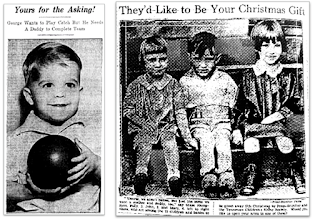
This was a great, but sad read. I, obviously, had no idea that Georgia Tann even existed, let alone what she did to these kids and families. Getting parents, often single mothers who "made a mistake" and would be shunned from their communities and families, to sign away their babies or poor families from the rural south doing the same because they couldn't afford to take care of them. There were even stories of, because of corrupt hospital workers and politicians, babies being stolen from their families while their mothers were still recuperating in the hospital after just having given birth. My heart ached for all the people. Tann kidnapped (in one way or another) these children and sold them as if their were hats or boots and she became a very, very wealthy woman. It's disgusting. This is two such ads where she would sell the "pretty" children: 


The worst part for me though--because many of the children were able to be placed in good, happy homes--was that at the end of the book  when at the reunion they went to the memorial that was erected for the 19 known deaths of babies who were under Tann's care at the Tennessee Children's Home Society. But the horrendous moment for me was when it was reveled that there were actually more than 500 children/babies who died under that roof if the child wasn't "pretty" or already sick. One of the people who's story we were given very easily could have been one of those babies who died. It breaks my heart. 

The compilation of all of these stories was very well put together. This is one that I think many should read and all should be aware of so then things like this doesn't happen again. Hopefully things have changed, though kidnappings and child slaves have gone more underground, but it all needs to stop.  

I hope that these once children are able to find peace and the answer they are looking for. Because of Ancestry and other DNA places, many of these survivors have been able to find biological families, but there are still so many questions that have gone unanswered and as time passes, may never be fully answered. 

I am very interested in hearing the story Before We Were Yours for the sheer fact that it changed so many lives. 


 This marker reads: 

"The Tennessee Children's Home Society
An Infamous History. A Tragic Legacy.
September 17, 1923 -- December 10, 1949


"In Memory of the 19 children who finally 
Rest here unmarked if not unknown, 
And of all the hundreds who died under
The cold hard hand of the Tennessee 
Children's Home Society. Their final resting 
Place unknown. Their final peace a blessing. 


"The hard lesson of their fate changed
Adoption procedure and law nationwide."

May you rest in peace.